


After a stroke, walking again—and walking fast enough to cross a street, do your shopping, or resume a social life—is often the number one priority. But which mobility aid should you choose when one side of the body is weakened?
A team from Liège University Hospital compared the standard quad cane and the Wheeleo® one-handed rollator in 34 patients. The result: a significantly higher walking speed with the Wheeleo®. Here is what the study found, how it was measured, and what remains to be explored.
Why Walking Speed Matters
Walking speed is the most widely used parameter for assessing gait quality. It is also a marker of robustness: the faster you walk, the more stable and autonomous you generally are. Conversely, slow and irregular gait is associated with a higher risk of falls and greater dependence.
According to the literature cited by the authors, approximately 70% of patients experience at least one fall during the first year after a stroke. A vicious cycle then sets in: fear of falling leads to staying at home, isolation develops, physical deconditioning follows—and the risk of falling increases further.
A clinical benchmark to keep in mind: a speed of at least 2.9 km/h (i.e., 0.8 m/s) is generally considered necessary for community ambulation—for example, to cross a street during a pedestrian light cycle.
The Study in Brief
Published in 2024 in the journal Healthcare, the study was conducted at two rehabilitation centers of Liège University Hospital by the physical medicine and rehabilitation team in collaboration with the University of Liège’s motion analysis laboratory. It received no external funding.
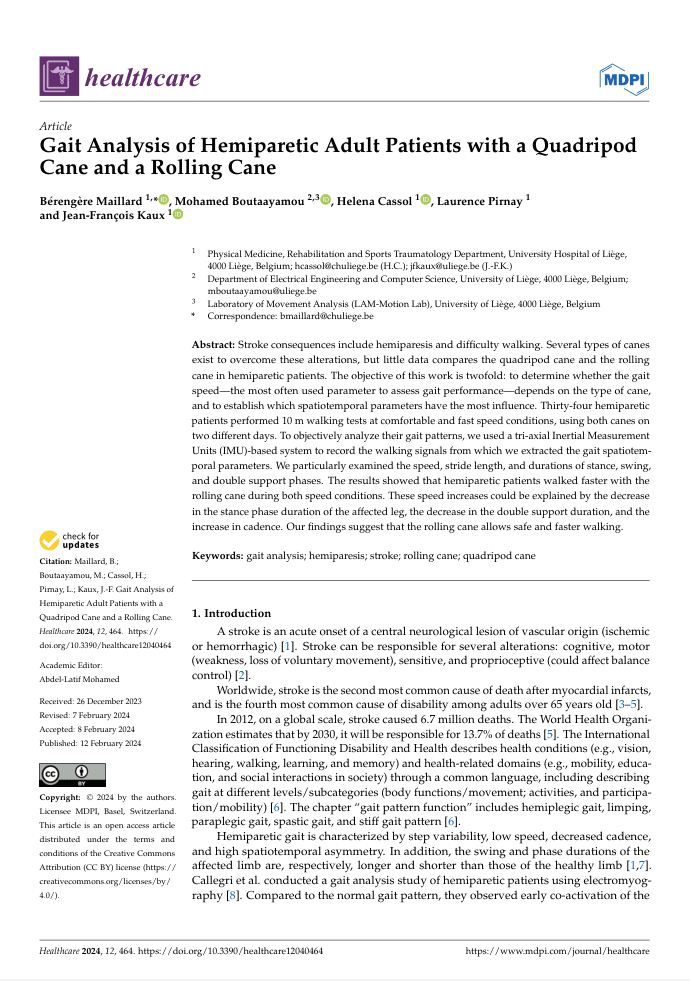
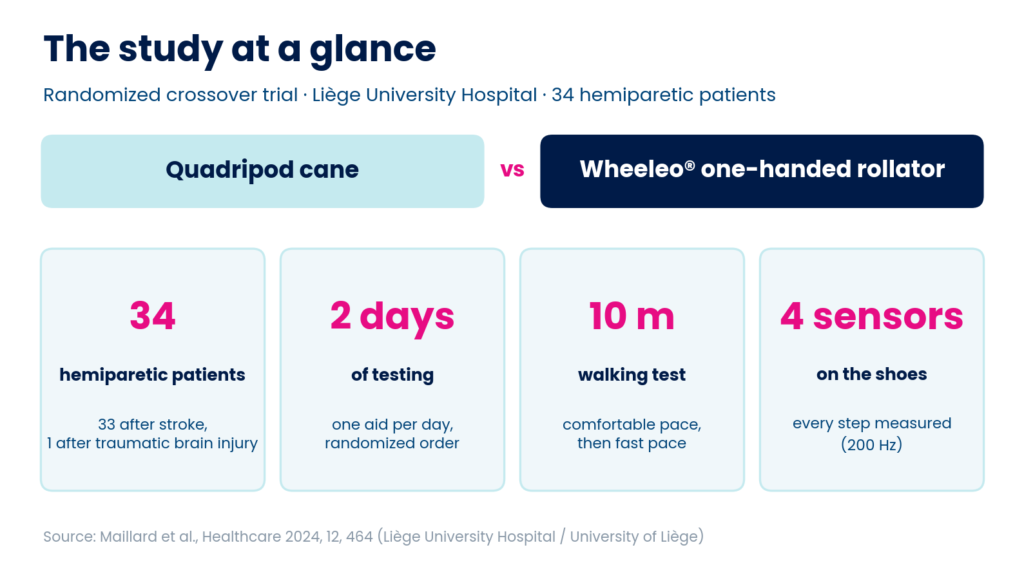
Thirty-four hemiparetic patients (33 after stroke, 1 after traumatic brain injury; median age 65 years, approximately 3 months post-injury) completed a 10-meter walk test, first at comfortable speed, then at fast speed. Each patient tested both aids on two different days in randomized order: this is called a randomized crossover trial. Each participant thus serves as their own control.
To measure each step with precision—rather than with a simple stopwatch—the researchers attached four small inertial sensors to the patients’ shoes.
What the Study Found
The main result is clear: patients walked faster with the Wheeleo® one-handed rollator than with the quad cane, at both comfortable and fast speeds.
- Comfortable speed: 1.57 km/h with the Wheeleo® versus 1.17 km/h with the quad cane—a +35% increase.
- Fast speed: 2.06 km/h versus 1.50 km/h—a +38% increase.
A telling detail: walking at comfortable speed with the Wheeleo® one-handed rollator (1.57 km/h) is already faster than walking at fast speed with the quad cane (1.50 km/h). This observation aligns with that of an initial crossover trial published in 2020 (Deltombe et al., Journal of Rehabilitation Medicine), which measured the same speed (approximately 1.6 km/h) in these two conditions.
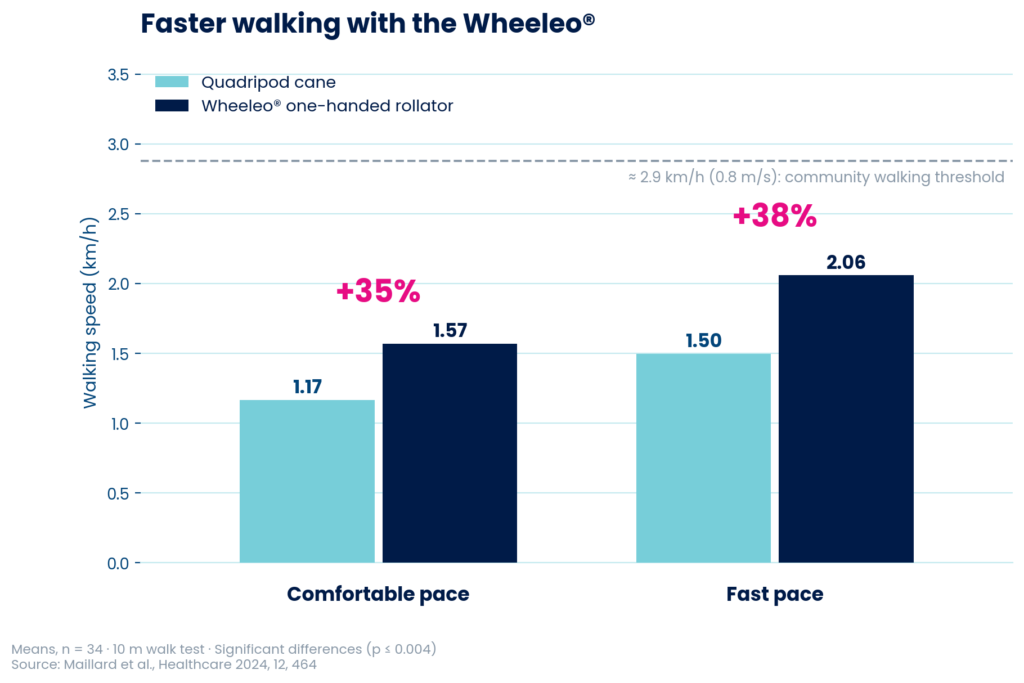
The graph also recalls the threshold of approximately 2.9 km/h mentioned above. We return to this in the section on limitations.
Why Do People Walk Faster?
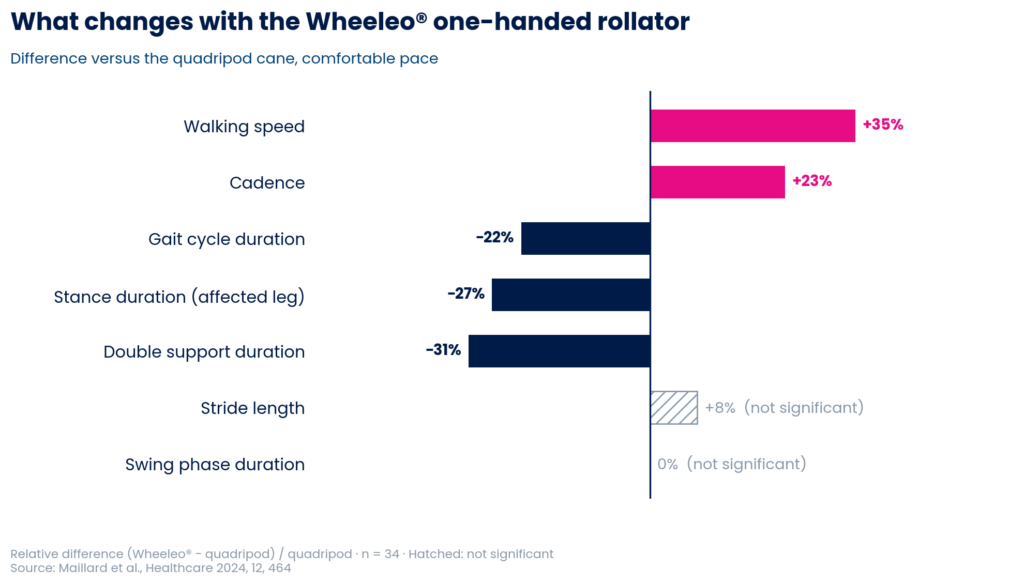
The sensors allow each step to be broken down. Walking speed is stride length divided by stride duration. Here, stride length does not change significantly: the speed gain therefore comes from a shorter gait cycle (−22%), in other words, a faster rhythm.
More specifically, with the Wheeleo® one-handed rollator at comfortable speed:
- the affected leg remains on the ground for less time with each step (stance phase −27%);
- the time when both feet are on the ground decreases (double support −31%);
- the number of cycles per second increases (cadence +23%).
The swing phase, when the leg is in the air, does not change.
Why? The authors propose a mechanical explanation. With the quad cane, walking occurs in “3 beats”: the aid must be lifted and then set down, creating a pause in each cycle. The Wheeleo® one-handed rollator moves by rolling: walking occurs in “2 beats,” with continuous support at each step. This is a plausible explanation, but the study did not test it directly.
What the Study Does Not (Yet) Say
A good study is also recognized by the candor of its limitations. The authors list several, and it is important to keep them in mind:
- Speeds remain below 2.9 km/h. Even with the Wheeleo®, patients do not reach the threshold for community ambulation. They were recruited early in their rehabilitation (approximately 3 months post-injury); the authors anticipate progression, but follow-up at 6 or 12 months remains to be done.
- A heterogeneous population. Functional levels, causes, and affected sides varied from patient to patient, and the study includes only hemiparetic individuals. Other pathologies (Parkinson’s disease, multiple sclerosis, orthopedic conditions, geriatrics, pediatrics…) are not covered.
- Hospital test conditions. Regular floor, observed patients, sometimes stressed or anxious about falling: conditions that differ from everyday walking.
- Fall risk was not assessed, nor was the energy cost of walking (oxygen consumption). The authors conclude that gait was faster and deemed safe, but these two points remain to be documented.
- A two-day comparison, with no assessment of what happens over the longer term.
A note on transparency: this study was conducted and analyzed by the Liège University Hospital team. InnoRehab, the company behind the Wheeleo®, simply loaned a device for the duration of recruitment; the authors declare no conflicts of interest and no external funding.
Key Takeaways
- In 34 hemiparetic patients, the Wheeleo® one-handed rollator enabled walking 35% faster at comfortable speed and 38% faster at fast speed than with the quad cane, confirming the results of an initial trial in 2020.
- The gain is explained by a shorter gait cycle: shorter stance phase, reduced double support, higher cadence, with no change in stride length.
- The proposed hypothesis is that of continuous support, without having to lift the aid at each step.
- This is a promising result, not a final conclusion: population limited to hemiparesis, hospital conditions, fall risk and energy cost not assessed.
The authors conclude with a message that all therapists will share: whatever aid is chosen, the essential thing is to get patients moving again.
Going Further
The authors announce a follow-up: analysis of gait symmetry and variability, using data already collected. But many questions remain open. What about other pathologies, in real-life settings, outdoors, in narrow spaces? What is the energy cost of walking, the effect on fall risk, on quality of life, on daily participation?
If you are a therapist, student, or instructor and these questions resonate with you, please feel free to contact us: geoffroy@wheeleo.eu.
References
- Maillard B, Boutaayamou M, Cassol H, Pirnay L, Kaux J-F. Gait Analysis of Hemiparetic Adult Patients with a Quadripod Cane and a Rolling Cane. Healthcare 2024; 12(4): 464. Open access—doi:10.3390/healthcare12040464
- Deltombe T, Leeuwerck M, Jamart J, Frederick A, Dellicour G. Gait improvement in adults with hemiparesis using a rolling cane: a cross-over trial. J Rehabil Med 2020; 52: 1-5. Access the article
