


Asking a patient to walk “as fast as possible” is a one-off exercise: useful for measuring maximum capacity or for supervised training, it is not a pace they can rely on daily.
In hemiparetic individuals, walking faster than their preferred speed is accompanied by reduced stability. In a treadmill study (Awad et al., 2023), the lateral movement of the pelvic center of mass was 17% more irregular at faster speeds. Patients spontaneously choose a speed faster than their most stable speed, but slower than their most economical speed. Another study (Hsiao et al., 2017) links the comfort speed of slow walkers to their ability to laterally transfer body weight onto the affected leg.
This finding appears in two studies, conducted by two different teams. It changes the way we look at walking speed—and perhaps the way we choose a mobility aid.
Two studies, two teams, one shared finding
Deltombe et al., 2020 (Journal of Rehabilitation Medicine): randomized crossover trial with 32 hemiparetic adults, recruited at Godinne (CHU UCL Namur) and Ottignies (Centre Hospitalier Neurologique William Lennox). Each patient completed a 10-meter walk test with the quad cane and then with the one-handed Wheeleo® rollator, first at spontaneous speed, then at maximum speed. Speed was measured with a stopwatch.
Maillard et al., 2024 (Healthcare): randomized crossover trial with 34 hemiparetic patients, in two rehabilitation centers at CHU de Liège. Same type of test (10 meters, comfortable then rapid pace), but with inertial sensors attached to the shoes to measure each step with precision.
A note on transparency: the founder of Wheeleo® is co-author of the 2020 study, which is declared in the article. The 2024 study was conducted by the Liège team, with no external funding; the company simply loaned a device.
Three speed levels for the same patient
In both studies, each patient served as their own control. We therefore observe, for the same person, three speed levels:
- Level 1—quad cane, spontaneous pace: approximately 1.2 to 1.3 km/h (0.32 to 0.36 m/s).
- Level 2—the same speed, two ways to achieve it: with the quad cane, by asking to walk as fast as possible, or with the one-handed Wheeleo® rollator, at spontaneous pace. Approximately 1.5 to 1.6 km/h. In 2020, the two values are identical (0.44 m/s); in 2024, the spontaneous speed with the Wheeleo® (0.436 m/s) is even slightly higher, in raw value, than the rapid speed with the quad cane (0.416 m/s).
- Level 3—one-handed Wheeleo® rollator, rapid pace: approximately 2.05 km/h (0.57 m/s), a nearly identical value in both studies (0.57 and 0.572 m/s).
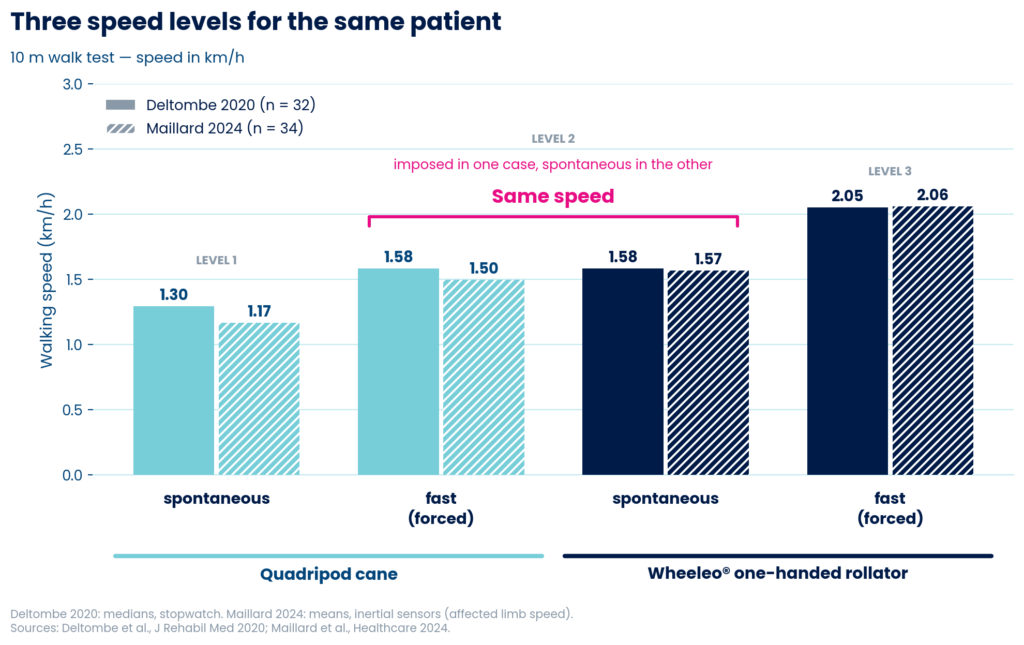
What is striking is the concordance: two teams, several centers, two measurement methods (stopwatch, then inertial sensors)—and very similar values.
Why forcing the pace is not a solution
Level 2 can therefore be reached in two ways. They are not equivalent.
Asking a patient to walk “as fast as possible” is a one-off, demanding exercise: it requires concentration and effort, and leaves less room to recover in the event of a loss of balance. It is useful for measuring maximum capacity; it is not a pace the patient adopts, or maintains, in everyday life. Forcing the pace therefore means accepting more discomfort, more instability and, very probably, a higher risk of falling.
An important clarification: these studies involve small samples and measure stability, not falls. Neither the 2020 nor the 2024 study directly measured the consequences of a forced pace. And walking fast is not to be prohibited: in supervised training, repeated fast walking is a recognized rehabilitation tool (Pressler et al., 2025). The point is elsewhere: achieving this speed naturally rather than by forcing it.
What the studies do show, however, is that the higher speed achieved with the one-handed Wheeleo® rollator did not come at the cost of effort. In the 2020 study, perceived exertion (Borg scale) and the physiological cost of walking remained unchanged, and the number of patients requiring therapist contact to maintain balance did not increase. Patient satisfaction, meanwhile, rose from 6 to 8 out of 10.
Speed, an indicator that matters
If this question deserves attention, it is because walking speed is one of the best indicators of a patient’s capacity. It is the most widely used parameter for assessing walking performance, and it is measured simply: a corridor, a stopwatch, ten meters.
It reveals a great deal. Slow, irregular walking is associated with a higher risk of falling, greater dependence and more comorbidities. Conversely, walking faster is a marker of robustness and better balance control. The 2020 study also notes that balance and walking speed are correlated with quality of life in hemiparetic adults.
Speed also makes it possible to position the patient against functional benchmarks. In the Perry classification, cited by the 2024 study, patients limited to walking at home move at an average of around 0.1 m/s, while “community” walkers reach 0.8 m/s, i.e., around 2.9 km/h: the speed needed to cross a street during a pedestrian green light.
Speed is not an end in itself, but an indicator that informs autonomy, safety and participation. A device capable of increasing it substantially—+22% and +35% at spontaneous pace, +30% and +38% at rapid pace according to the two studies—should therefore not be set aside: it acts on the indicator that matters.
A speed that fuels rehabilitation
Walking faster spontaneously also means walking more in the same time. In the 2020 study, during the six-minute walk test, the distance covered increased from 131 to 195 meters with the one-handed Wheeleo® rollator (+49%), nearly half again as much distance for the same duration.
This is a rehabilitation issue. The authors of the 2024 study note, drawing on the literature, that the most important factor for improving walking quality and speed is to increase the amount of walking exercise during rehabilitation. Their conclusion is summed up in one sentence that all therapists will share: whatever aid is chosen, let us get patients moving again.
A patient who walks faster with an appropriate aid, without having to force themselves, is a patient who can train more, longer and more naturally, within the framework defined with their care team. The 2020 authors even suggest that this increased speed and improved satisfaction could contribute to greater autonomy, and therefore better social participation.
Provided, of course, that the safety of this walking is confirmed outside supervised tests: this is the subject of the following section.
What remains to be demonstrated
These two studies are consistent with each other, but they do not tell the whole story:
- Supervised tests, in a hospital setting. The 2020 study specifies that the device was evaluated only under therapist supervision, indoors; the 2024 study notes that a hospital floor is more regular than an outdoor surface.
- The risk of falling in real life remains to be documented. In 2020, the number of therapist contacts did not increase, which is encouraging under supervision; in 2024, fall risk was not assessed. The authors of both studies call for work in real-world conditions.
- No follow-up over time. A higher spontaneous speed is an immediate result. That it translates, over time, into better recovery is a reasonable hypothesis, but it has not been tested.
- A restricted population. The patients were hemiparetic following a stroke or traumatic brain injury. Other pathologies are not covered.
- Speeds that remain below the 0.8 m/s threshold (approximately 2.9 km/h) for community ambulation.
All of these are still open research questions. If you are a therapist, student or instructor and these resonate with you, please feel free to write to us: geoffroy@wheeleo.eu.
References
- Deltombe T, Leeuwerck M, Jamart J, Frederick A, Dellicour G. Gait improvement in adults with hemiparesis using a rolling cane: a cross-over trial. J Rehabil Med 2020; 52: jrm00078. Access the article—doi:10.2340/16501977-2705
- Maillard B, Boutaayamou M, Cassol H, Pirnay L, Kaux J-F. Gait Analysis of Hemiparetic Adult Patients with a Quadripod Cane and a Rolling Cane. Healthcare 2024; 12(4): 464. Open access—doi:10.3390/healthcare12040464
- Awad LN, Knarr BA, Kudzia P, Buchanan TS. The Interplay Between Walking Speed, Economy, and Stability After Stroke. J Neurol Phys Ther 2023 ; 47(2) : 75-83. doi:10.1097/NPT.0000000000000431
- Hsiao H, Gray VL, Creath RA, Binder-Macleod SA, Rogers MW. Control of lateral weight transfer is associated with walking speed in individuals post-stroke. J Biomech 2017 ; 60 : 72-78. doi:10.1016/j.jbiomech.2017.06.021
- Pressler D, Schwab-Farrell SM, Reisman DS, Billinger SA, Boyne P. Effects of maximal speed locomotor training on spatiotemporal gait changes in individuals with chronic stroke: a secondary analysis of a randomized controlled trial. Gait Posture 2025 ; 122 : 232-239. doi:10.1016/j.gaitpost.2025.07.325
