


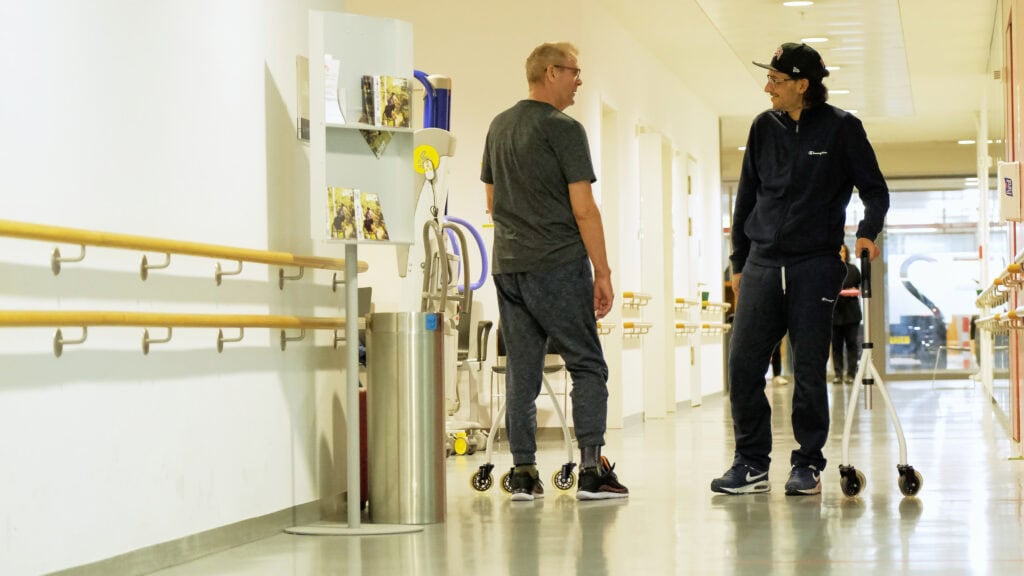
Hemiplegia is a complete paralysis of one side of the body—arm, leg, and sometimes the face—caused by brain damage, most often a stroke. The most frequent question is immediate and legitimate: can a person with hemiplegia walk? The answer is yes, in many cases, provided there is early, intensive rehabilitation adapted to the unilateral constraint of the paralysis. This guide reviews the mechanisms of hemiplegic gait, the stages of rehabilitation, and the technical aids that allow for regaining real daily mobility.
The word comes from the Greek ‘hêmi’ (half) and ‘plêgê’ (strike). A lesion in the left hemisphere of the brain leads to right-sided hemiplegia, and vice versa, because the motor pathways cross at the brainstem. The affected leg loses its strength, balance, and fine motor control: it no longer lifts correctly, no longer provides a secure support, and compromises the entire walking cycle.
When the weakness is partial rather than total, it is called hemiparesis. In both cases, gait rehabilitation is at the heart of the recovery program.
Gait recovery depends on several cumulative factors: the extent and location of the brain lesion, age, comorbidities, and especially the intensity of rehabilitation in the first weeks. Neuroplasticity allows adjacent or contralateral areas of the brain to take over some of the lost motor functions, including those controlling the leg.
In practice, three levels of walking are observed after hemiplegia:
The first level is what rehabilitation aims for, but even the second represents a considerable gain in independence and quality of life.
Understanding these obstacles helps to grasp why gait rehabilitation is progressive and multidisciplinary:
A stroke occurs when the blood supply to part of the brain is interrupted, either by a clot (ischemic stroke) or a ruptured vessel (hemorrhagic stroke). Other causes include:
The cause determines the prognosis for gait recovery: an ischemic stroke treated quickly often leaves good prospects for functional rehabilitation.
Gait rehabilitation takes place in several progressive stages:
Before standing up, physiotherapy works on passive mobilization of the leg, awareness of the affected limb, and proximal muscle strengthening (hip, trunk). The goal is to prepare for seated and then standing balance before taking the first step.
Verticalization is a key step: the person with hemiplegia regains a standing position first with human assistance, then with support. The first steps are guided and secured, often using parallel bars. Dynamic balance is worked on from this phase.
The physiotherapist corrects circumduction, works on knee flexion, and lifting the foot with each step. Functional electrical stimulation may be used to stimulate the foot lifter muscles and combat foot drop.
Walking is retrained outside of controlled conditions: uneven ground, slopes, stairs, outdoor spaces. It is at this stage that final technical aids (ankle-foot orthosis, one-handed walker) are evaluated and prescribed.
The first months are decisive, as neuroplasticity is at its peak. However, progress remains possible beyond one year, particularly in gait quality and endurance.
It is custom-molded or thermoformed according to the person’s degree of spasticity and activity. Worn inside the shoe and lightweight, it often becomes a permanent walking accessory. It does not replace muscle rehabilitation, but it allows the person to walk safely from the first weeks, which accelerates overall recovery.
A traditional walker requires symmetrical pressure from both hands to guide the trajectory and absorb weight with each step. In a person with hemiplegia, the affected upper limb cannot perform this function: the aid is difficult to handle, becomes unstable, and the risk of falling increases, which slows down gait rehabilitation.
The Wheeleo® one-handed walker is designed for this profile. It is steered entirely with one hand, rolls on the ground without being lifted at each step, and offers continuous lateral support that secures balance during walking.
The choice of a technical aid is ideally made with the physiotherapist or occupational therapist, who evaluate residual balance, the strength of the healthy upper limb, and the constraints of the living environment (stairs, narrow corridors, outdoor ground). To compare available options, visit our page on the one-handed walker and our walker accessories.
The table below places hemiplegia in relation to other often-confused forms of paralysis and their impact on walking.
| Term | Affected area | Impact on walking |
| Hemiplegia | One side of the body (arm + leg) | Disrupted walking, unilateral rehabilitation |
| Hemiparesis | One side, partial weakness | Walking possible with compensation, prognosis often better |
| Paraplegia | Both legs | Walking impossible or very limited without heavy equipment |
| Tetraplegia | All four limbs | Walking impossible, wheelchair essential |
The neurologist evaluates the muscle strength of each muscle group according to the MRC scale (from 0 = no contraction to 5 = normal strength), tests reflexes, sensitivity, and coordination. This functional mapping serves as a reference for tracking gait rehabilitation progress week after week.
When faced with sudden signs, the FAST method (Face, Arm, Speech, Time), promoted by the American Stroke Association, helps to react quickly: drooping face, arm weakness, speech difficulty, time to call. Call 112 immediately. Every minute saved preserves brain tissue and improves the chances of walking again.
Q: Can a person with hemiplegia walk?
Yes, in many cases. Thanks to physiotherapy, ankle-foot orthoses, and a mobility aid adapted for one-handed use like a one-handed walker, a large proportion of people with hemiplegia regain independent or safe walking.
Q: How long does it take to walk again after hemiplegia?
Initial walking progress often appears within the first few weeks for moderate forms. Most functional recovery occurs within the first three to six months. Gains in gait quality and endurance remain possible beyond one year with continued rehabilitation.
Q: What is the best walker for a person with hemiplegia?
A person with hemiplegia cannot safely use a standard two-handed walker because the affected upper limb cannot maintain a grip. A one-handed walker, such as the Wheeleo®, is specifically designed for this profile: it is steered with one hand, rolls without being lifted, and offers stable lateral support.
Q: What is the cause of hemiplegia?
The most common cause is a stroke. Other causes exist: traumatic brain injury, brain tumor, brain infection (meningitis, encephalitis), or hemiplegic cerebral palsy present from birth.
Q: What is the difference between hemiplegia and a stroke?
A stroke is the cause, hemiplegia is the consequence. A stroke damages the brain; hemiplegia is the resulting paralysis of one side of the body. Not all strokes cause hemiplegia, and hemiplegia can occur without a stroke.
Q: Is it possible to recover from hemiplegia?
Complete recovery is possible in mild forms with early and intensive rehabilitation. In severe cases, the goal is maximum functional recovery, particularly of walking, rather than total restoration.
Regaining the ability to walk after hemiplegia requires adapted rehabilitation and mobility aids designed for one-handed support.
Discover the one-handed walker at wheeleo.eu and speak with our team to evaluate your situation.
Written by the Wheeleo® editorial team, in collaboration with physiotherapists and occupational therapists specializing in gait rehabilitation and mobility aids for people with reduced mobility.
This article is for informational purposes and does not replace medical advice. Consult a healthcare professional for any decision regarding your situation.
Three key points to remember

Good news, the Wheeleo® is available in your area.
To do so, please visit our local partner!
Good news, the Wheeleo® is available in your area.
To do so, please visit our local partner!
Good news, the Wheeleo® is available in your area.
To do so, please visit our local partner!
Good news, the Wheeleo® is available in your area.
To do so, please visit our local partner!
Good news, the Wheeleo® is available in your area.
To do so, please visit our local partner!
Good news, the Wheeleo® is available in your area.
To do so, please visit our local partner!