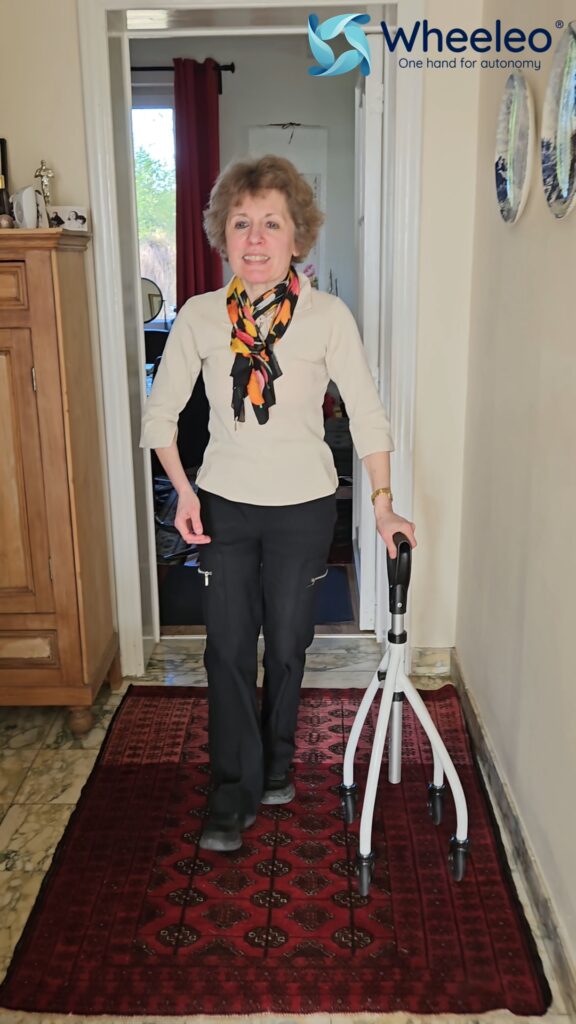
As a professional pianist, Olga has found the Wheeleo® to be an unobtrusive, stylish and ultimately indispensable companion.
When you live with multiple sclerosis, every mobility aid tells a story. Olga’s begins with a series of trials – foot lifts that didn’t work, canes that offered too little balance, a four-wheeled rollator deemed too cumbersome, too present, too “in front of you”.
“The four-wheeled rollator is someone in front of you. Whereas the Wheeleo® is right next to you. That’s the great thing.”
It was Olga herself who insisted on trying the Wheeleo®. Her physiotherapist, who had worked at Melsbroek (National MS Center), was familiar with it – but had not suggested it to her. A walk together was enough to convince everyone.
What Olga describes is not simple functional satisfaction. It’s a relationship. She named her Wheeleo® Freddy – after Freddy Mercury, her favorite artist. “I personalize it like a friend,” she says, with an obviousness that goes beyond the anecdotal. Getting to grips with a walking aid also means learning to live with your body in a different way.
Olga is a professional pianist. She gave concerts, signed contracts, led a busy career – until MS came along and redefined the contours of what was possible. Rather than break with music, she chose to pursue it in a different way: by exploring the links between musical practice and neurology, between sound and brain. What we now call music therapy.
The Wheeleo® accompanies this active life: to the doctor, to the physiotherapist, to the library, to a concert, sometimes to class – “sometimes I need it, sometimes I don’t”. This flexible freedom says a lot about what the right tool can do, at the right time.
Olga isn’t keeping her discovery to herself. As a member of the Belgian Multiple Sclerosis League, she has shared her experience with several friends – and many have adopted the Wheeleo® in their turn. As for the stares in the public eye, they don’t worry her: “People ask questions, especially in hospitals. And then I explain. It’s enough to have a dialogue, it’s enough to be heard.”
A simple message, delivered with calm: assisted mobility has nothing to hide. And trust, once found, changes everything.
“It’s a companion that goes well with you. You have to try it – really try it. And as soon as you have the confidence, then it works.”