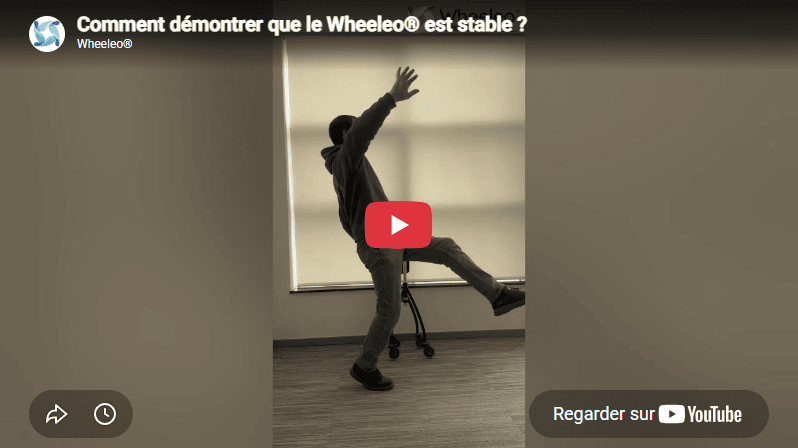
Convincing an able-bodied person that the Wheeleo® is stable is not achieved through long explanations, but through a thirty-second practical demonstration. It is this simple and immediate stability test that I present in the short video below, and that I suggest you replicate with your loved ones or patients.
A provoked imbalance, without an assistive device
The principle is intentionally basic. A person with no walking difficulties is asked to stand on one foot, if possible on their tiptoes. In the vast majority of cases, the person struggles to hold the position: the body sways, the arms rise to compensate, and balance becomes difficult to maintain beyond a few seconds. This first step is not an athletic feat to be achieved; it serves solely as a point of comparison, much like a ‘before and after’.
The same imbalance, Wheeleo® in hand
The same person is then asked to repeat exactly the same exercise, this time with the Wheeleo® in hand. The contrast is immediate: stability improves significantly, and the small balance adjustments that were problematic without help are managed naturally, as the Wheeleo® moves itself according to the person’s support needs, without them having to think about it.
What this demonstration allows one to feel is a central characteristic of the Wheeleo® design: unlike a cane, which is lifted and then placed down with each step and therefore only offers intermittent support, the Wheeleo® remains in constant contact with the ground. It is this continuity of support, combined with its freedom of movement in all directions, that explains why the device absorbs small imbalances without ever pulling the person forward or to the side.
Why this test is useful in practice
The purpose of this exercise is not to demonstrate athletic performance, but to alleviate a frequent concern: many patients, and sometimes those around them, are wary of an assistive device that has no brakes and fear that it might unbalance them or slip away. Having a loved one or an able-bodied client experience this test, outside of any clinical context, makes tangible in a few seconds what theoretical explanations sometimes struggle to convey.
I invite you to try this test with those around you, and to watch the video to see the demonstration in a real-life situation.
Geoffroy Dellicour est kinésithérapeute au Centre Hospitalier Neurologique William Lennox (Belgique) depuis plus de 20 ans. Il est le concepteur du Wheeleo®. Il a une sérieuse expérience en rééducation. Il est passionné par l'innovation et la rééducation de la marche.