


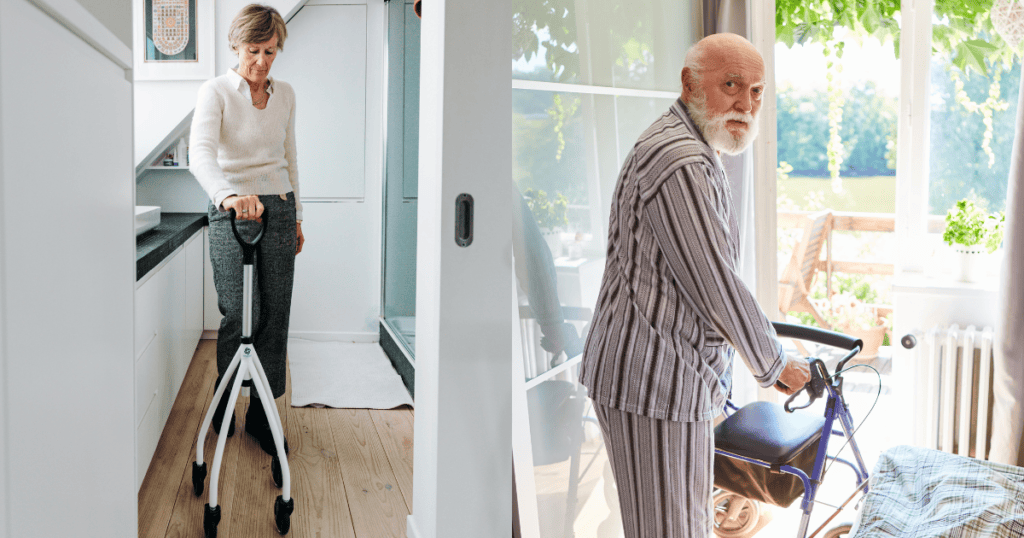
For people with reduced mobility, the majority of their daily movements take place inside the home. However, walking aids are often designed primarily for outdoor use. This logic frequently leads to the use of a rollator for outings, while at home, no really adapted aids are put in place.
It’s essential to equip yourself for the most common walking situations. In everyday life, a large proportion of journeys are made within the home, placing heavy demands on mobility, balance and endurance. The choice of walking aid therefore has a direct impact on the quality and regularity of these journeys, while remaining consistent with and complementary to outdoor needs.
The rollator, or walker, is one of the solutions available alongside the cane, walking frame or wheelchair. Each aid meets a specific need, but it must be used where it is really needed. A sturdy rollator is reassuring. But when you have to fold it, carry it to the car or take it up in an elevator, the weight quickly becomes an obstacle. Wheeleo® has made lightness its priority, without sacrificing sturdiness.
The rollator provides important stability thanks to its continuous support. Some models incorporate a basket, seat or other practical accessories, making them an ideal solution for outdoor use or for running errands. The weight of a standard rollator, generally between 6 and 9 kg depending on design and materials, is calibrated to offer the sturdiness needed for uneven outdoor surfaces.
Inside the home, however, these features can become a real constraint. The rollator’s size, often close to 60 cm wide, makes it difficult to get around in narrow corridors, between furniture or in cluttered rooms. Even a lightweight rollator can lack maneuverability in tight spaces. It’s the bulk, not the weight, that’s the problem: in an interior, you don’t carry your rollator, you maneuver it, and every centimeter counts.
For this reason, many users leave their rollator at the entrance or in a storage room and move around indoors, often without adapted aids.
Without a walking aid in the home, many people find that their situation is acceptable, even if they can’t get around in optimal conditions. They rely on walls, furniture or doorframes to maintain their balance, in the absence of stable support close at hand.
This strategy relies on permanent compensations. Balance becomes unstable, posture deteriorates and walking requires greater effort. Fatigue increases and the risk of imbalance remains, even if the situation seems under control.
In the long term, this way of moving around reduces comfort and quality of mobility, but above all increases the risk of falls.
The cane provides occasional assistance, but becomes insufficient when balance is fragile. A walking frame with plugs provides fixed support, but requires lifting with each step, which limits the fluidity of movement.
The wheeled rollator enables continuous walking, but its size is often incompatible with the constraints of the home. The folding walker provides a partial solution to this problem, by taking up less space when stored, but once deployed, its weight and width remain the same: the constraint of circulation, for its part, does not disappear. Every aid has its place, but none fully meets the specific requirements of indoor walking unless it has been designed for this purpose.
When walking becomes very difficult, some walkers can be transformed into transfer chairs. This chair combines the functions of a rollator with those of a powered chair, enabling a companion to take over without changing equipment. It generally weighs more than a conventional rollator, making it ideal for situations where independent mobility is very limited.
Wheeleo® has been designed to meet the real constraints of walking at home. It’s a walker specifically adapted for indoor use, designed to accompany the majority of daily journeys. With the lightest weight on the market, it makes a real difference to everyday life: easier to maneuver in confined spaces, simpler to slip into the trunk of a car. And this low weight doesn’t mean it’s not sturdy: it provides sufficient anchorage to the ground to guarantee stability and safety at every touch.
Compact and maneuverable, it moves easily between furniture and in tight spaces. It blends seamlessly into its surroundings. It remains unobtrusive, stands upright when dropped, and is always in the right place to accompany movement. Height-adjustable handles promote upright posture and greater stability. Its low weight makes it easy to use and sets it apart from other walkers designed for outdoor use.
Wheeleo® is more than just a support. It guides gait, reduces compensation and enables smoother, more comfortable movement. It’s intuitive to use and generates very few daily constraints, which explains why users have adopted it for so long.
The rollator can then be used as a complement, particularly for outings or walks outside, when distances are longer, the quality of the ground is not optimal and the need to rest, transport objects or run errands takes priority. This complementary choice between the two aids guarantees mobility adapted to every living situation.
Improving mobility in the home is a key factor in preserving independence. It is in this environment that movement is most frequent and repetitive. Using an adapted walker makes moving around safer, reduces fatigue and makes moving around the home more comfortable.
When the risk of falling increases, it’s not falls that first increase, but activity that decreases: the person moves less, loses walking ability and enters a vicious circle of maladaptation. Conversely, a walker whose weight, frame and comfort correspond to the user’s real needs will be adopted over the long term. A walking aid that reduces the risk of falling promotes activity maintenance, boosts confidence and engages the person in a virtuous circle of mobility.
The Wheeleo® is a one-handed walker for indoor use, complemented by a rollator for outdoor use, to provide lasting support for mobility in all living situations.

Good news, the Wheeleo® is available in your area.
To do so, please visit our local partner!
Good news, the Wheeleo® is available in your area.
To do so, please visit our local partner!
Good news, the Wheeleo® is available in your area.
To do so, please visit our local partner!
Good news, the Wheeleo® is available in your area.
To do so, please visit our local partner!
Good news, the Wheeleo® is available in your area.
To do so, please visit our local partner!
Good news, the Wheeleo® is available in your area.
To do so, please visit our local partner!