


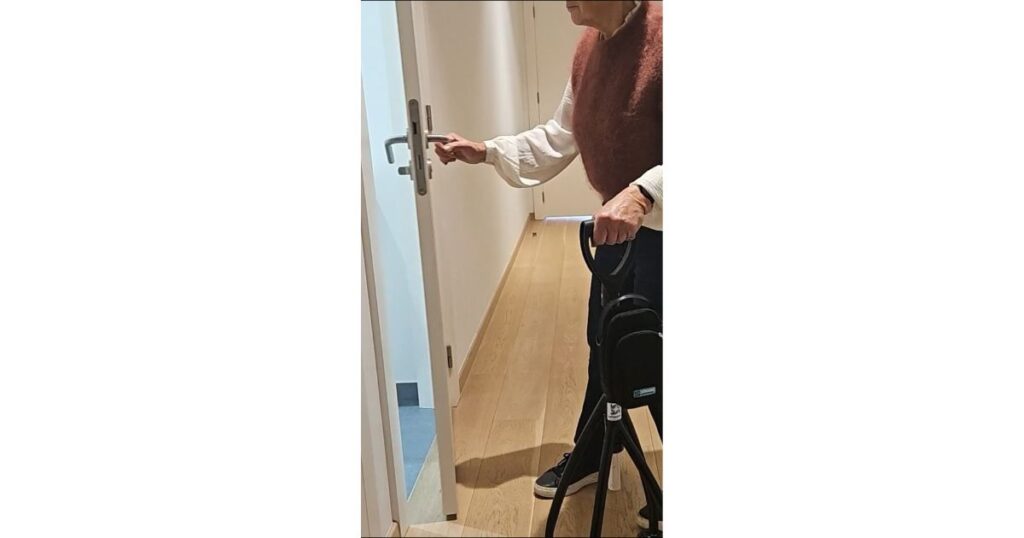
Entering and exiting the toilet with a walker presents a challenge that few devices truly solve: that of available space and grip. In this demonstration, a one-handed walking aid, the Wheeleo®, is used to complete the entire journey — walking down the hallway, opening the door, entering, turning around, exiting, closing the door, and turning off the light — without ever releasing the support.
The Challenge of Space and Grip
Toilets are often one of the most restrictive spaces in a home: narrow door, little room to maneuver, and a U-turn to be made in a reduced area. For a person who needs a walking aid, this poses two distinct problems. On the one hand, a classic walker, held with two hands, often requires it to be left in the hallway due to lack of space to pivot it, or to release one side to squeeze through the door. On the other hand, a cane, being narrower, is easier to maneuver in the space but offers only intermittent support: during a U-turn or change of direction, it is generally repositioned in the air before returning to the ground, creating a brief moment without support — precisely when balance is most challenged during the pivot.
What the Video Shows
The Wheeleo® is a one-handed walker: only one hand is needed to move, the other remains available for action. In this video, the person filmed maintains their support on the Wheeleo® from the beginning to the end of the sequence, including during the two most demanding moments: passing through the doorway and making a U-turn inside, in a restricted space.
Specifically, the free hand is successively used to open the door, close it once inside, then open it again to exit, close it behind oneself, and finally operate the light switch. Five functional actions performed in sequence, without any of them requiring the interruption of support on the walker.
The on-the-spot U-turn, performed inside the toilet, is made possible by the Wheeleo®’s wheels, which remain in contact with the ground even during tight pivots. The device therefore does not need to be lifted or repeatedly repositioned to change direction in a confined space — a limited turning radius, meaning the minimum space required to turn around, which is particularly well-suited to this type of cramped room.
Stability That Doesn’t Just Depend on Grip
Once inside, the person can release the Wheeleo® to manage with both hands — without it slipping away or falling — then resume holding it to exit. The device’s stability therefore does not rely solely on continuously holding it: it is also present when it is set down and left unattended for a few moments.
Impact on Daily Life and Independence
What this video highlights goes beyond simply passing through a door. It is the ability to perform, autonomously and without external assistance, a sequence of actions that combines movement, door manipulation, and clothing management — in one of the most cramped and frequently used spaces in the home. For a person whose walking requires assistance, this type of daily scenario directly determines the possibility of remaining autonomous at home, without systematically depending on a third party for such journeys.
